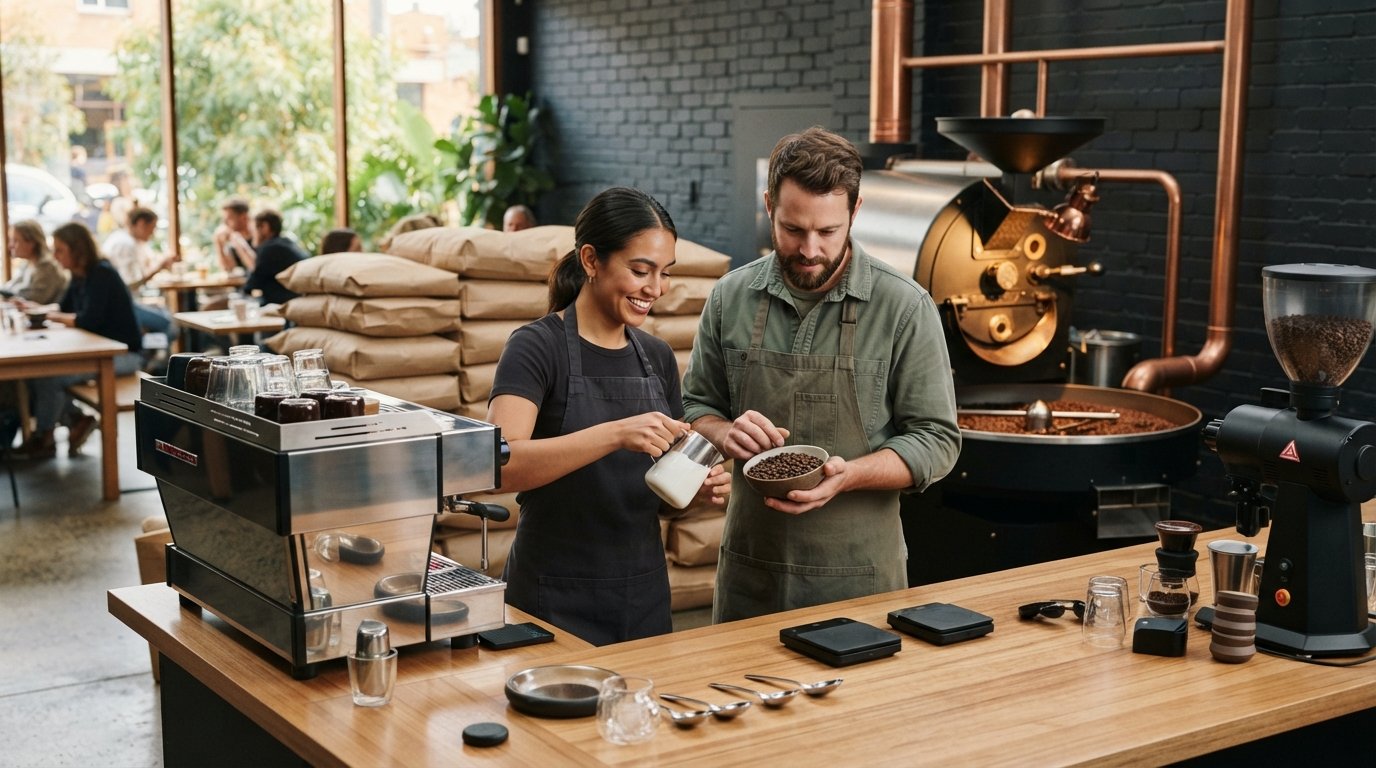
A mediocre cup of coffee is no longer just a missed opportunity. It is a brand liability. In a global market projecting a record 183.6 million bags for the 2025/2026 season, volume is easy to find. Quality is not. You have likely felt the sting of inconsistent roast profiles that alienate your regulars. You have dealt with the silence of providers who treat your business like a transaction rather than a craft. Reliable commercial coffee bean suppliers should offer more than just a product. They should offer a standard.
We understand this pursuit of perfection. Since 1999, we have seen how the right partnership transforms a hospitality site from a simple stop into a destination. This guide shows you how to identify and partner with providers who elevate your business standards for 2026. You will learn to secure high-grade specialty beans that remain consistent across every location. We preview the industry shift toward the new SCA Coffee Value Assessment framework and the technical support required for high-volume environments. Excellence is a choice. It starts with your supply chain.
Key Takeaways
- Vet commercial coffee bean suppliers using technical roasting markers and transparent roast dating. Guarantee consistency across every site.
- Prioritise cost-per-cup over price-per-kilo. Specialty grade beans offer superior extraction and reduced waste for healthier margins.
- Secure a national supply chain capable of maintaining freshness. Logistics must match the volume and speed of your business.
- Leverage 25 years of artisan roasting expertise. Partner with an authority that leads by example in the specialty coffee movement.
Identifying the Right Commercial Coffee Bean Suppliers
Selecting a partner is a strategic pivot for any hospitality business. It is not merely a matter of logistics. The best commercial coffee bean suppliers act as the silent foundation of your brand. They dictate the consistency of every espresso served and the loyalty of every customer who walks through your door. In the Australian market, the standard has shifted. Convenience is no longer the primary metric; craft is.
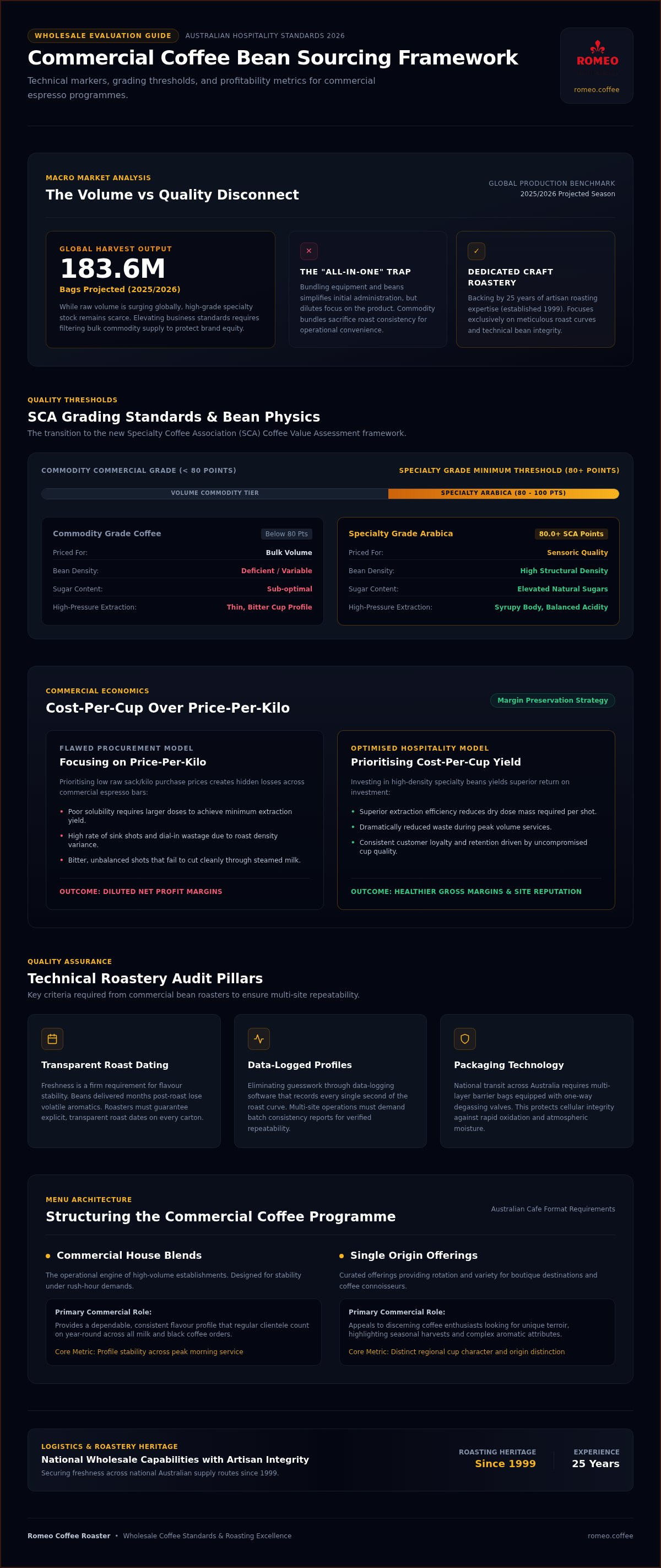
Avoid the "all-in-one" trap. Many vendors bundle equipment and beans to simplify operations. While this seems efficient, it often dilutes the focus on the product. A dedicated roastery prioritises the meticulous process of the roast. This ensures that every batch meets the rigorous standards of the specialty coffee grading scale. By focusing on beans that score 80 points or higher, you ensure a level of quality that commodity-grade suppliers simply cannot match. You aren't just buying a bean. You are investing in a reputation.
Defining Your Business Standards
Start by assessing your daily output. High-volume environments require absolute stability. Peak-hour demands will test the resilience of your bean profile and your supplier's ability to deliver. Consider how coffee fits into your brand identity. Are you a high-speed service hub or a boutique destination? Your coffee programme should reflect this choice.
- House Blends: These provide a reliable, consistent flavour profile that regulars can count on year-round.
- Single Origin Coffee: These offer variety and appeal to discerning enthusiasts looking for unique terroir.
- Volume Requirements: Ensure your supplier can scale without sacrificing the artisan roasting process.
The Value of a Long-Term Roastery Partnership
A transactional relationship is fleeting. A partnership is enduring. Since 1999, we have seen businesses flourish when they align with a supplier's established authority. Your choice of commercial coffee bean suppliers signals your commitment to excellence. It is a shared appreciation for high standards. When your supplier values the craft as much as you do, the result is a partnership that adds value beyond the product. It is about moving beyond a simple order to a strategic vision for growth.
Shared values in sourcing and roasting create a narrative that your customers will notice. They value transparency. They value consistency. Most importantly, they value a cup that tastes exactly as it should, every single time.
Criteria for Quality: Evaluating Your Wholesale Options
Quality is not a vague descriptor. It is a measurable outcome. When vetting commercial coffee bean suppliers, you must look beyond the brand story to the technical precision of the roast. Superior roasting is defined by transparency. This begins with the roast date. Freshness is a hard requirement for flavour stability. Beans delivered months after roasting lose the volatile aromatics that define a premium cup. If a supplier cannot provide a clear roast date, they aren't prioritising your success.
Packaging technology is equally critical. For national transit across Australia, suppliers should utilise one-way degassing valves and multi-layer barriers. These protect the beans from oxidation and moisture. Adhering to Specialty Coffee Association standards ensures that the product you receive meets global benchmarks for physical defects and sensory quality. It's about protecting the integrity of the bean from the roastery to the hopper. Every step in the supply chain must serve the final flavour.
Consistency is the Benchmark of Excellence
Excellence is only valuable if it's repeatable. In a high-volume environment, your customers expect the same flavour profile on a Tuesday morning as they do on a Saturday afternoon. This requires commercial coffee bean suppliers to invest in advanced roasting technology capable of precise profile replication. We utilise data-logging software to track every second of the roast. This eliminates guesswork. To verify this, ask your supplier for batch consistency reports. A true artisan roaster welcomes this scrutiny. It proves their mastery over the craft.
Sourcing Integrity and Bean Grading
The distinction between commodity grade and specialty Arabica is stark. Commodity coffee is priced for volume. Specialty coffee is priced for quality. For your business, espresso beans must be specifically graded to withstand high-pressure extraction. If a bean lacks the necessary density or sugar content, the resulting shot will be thin and bitter. High-grade beans ensure a syrupy body and balanced acidity that cuts through milk perfectly.
Direct trade models offer a level of traceability that traditional sourcing cannot match. It ensures that the premium you pay supports the farmers who produce the highest-grade lots. This integrity flows through to your final product. If you're ready to elevate your standards, consider partnering with a roaster that prioritises these technical markers. It's the difference between serving a drink and delivering an experience.
Specialty vs. Commercial Grade: The Profitability Framework
Profitability in a high-volume cafe is often misunderstood. Many commercial coffee bean suppliers lead with a low price-per-kilo. It's a seductive figure. However, it rarely reflects the true cost of service. Sophisticated operators look at the cost-per-cup. This is where specialty grade coffee proves its value. High-grade beans possess superior solubility. They extract more efficiently. You often find that a smaller dose of specialty coffee produces a more intense, balanced shot than a larger dose of commodity beans. Waste decreases. Profitability increases.
Customer retention is the secondary driver. In Australia, the coffee culture is established. Expectations are high. If the quality of the cup fluctuates, loyalty vanishes. According to USDA coffee market and trade reports, global supply chains are increasingly segmented by quality. Choosing the higher tier isn't just about taste. It's about securing a reliable supply of the top 5 to 10 percent of global production. This secures your brand against the mediocrity of the mass market.
The Flavour Profile Advantage
Specialty beans offer inherent sweetness and complexity. Commodity grade coffee relies on dark roasts to mask defects. This results in a bitter, ashy profile. When you serve a naturally sweet espresso, the need for expensive syrups and additives diminishes. You're meeting the demands of a palate that values the artisan process. It's a refined taste. It's a standard that justifies a premium menu price. Your customers aren't just buying caffeine. They're buying a sensory experience they can't replicate at home.
Operational Efficiency with Better Beans
Quality impacts the bench, not just the cup. Specialty beans are easier to dial in. Their density is consistent. This leads to predictable grinder performance and less time spent troubleshooting shots during peak periods. Cleaner, better-roasted coffee also reduces the buildup of oils and carbon in your equipment. Your machines run better. They last longer. By partnering with commercial coffee bean suppliers who prioritise specialty standards, you're investing in the mechanical health of your business as much as its sensory output. Efficiency is found in the details of the roast.
Logistics and Reliability: National Supply Requirements
Logistics is the bridge between the roastery and the cup. Without a robust distribution network, even the finest roast is compromised by time and temperature. Leading commercial coffee bean suppliers must offer more than just quality; they must offer certainty. In the Australian market, where geography presents unique challenges, your partner needs a proven ability to maintain freshness from the cooling tray to the hopper. This requires a sophisticated understanding of national freight lanes and climate-controlled storage.
Freshness is a perishable asset. For commercial accounts, the goal is to have coffee reach the cafe within 7 to 21 days post-roast. This window allows for optimal degassing while ensuring the volatile aromatics remain intact. Managing this at scale requires precision. It involves streamlined ordering systems that respect the pace of high-volume environments and lead times that allow for predictable inventory management. Whether you require standard 1kg retail bags or 2.5kg bulk wholesale solutions, the delivery must be punctual.
The Backbone of National Distribution
Scalability is the true test of a roastery. A sudden spike in volume should never result in a dip in quality or a delay in dispatch. Reliable commercial coffee bean suppliers maintain a production capacity that anticipates growth. This includes managing domestic LTL (Less-Than-Truckload) freight, where pallet limits typically cap at 1,500 to 2,000 lbs. This volume represents approximately 10 to 14 standard 60kg bags. Understanding these logistics ensures that your supply chain remains uncluttered and efficient. Reliability is not an accident. It is the result of a methodical approach to distribution.
- Freight Reliability: Using couriers that understand the time-sensitive nature of roasted coffee.
- Climate Control: Protecting green and roasted inventory from Australia's extreme temperature fluctuations.
- Volume Readiness: The infrastructure to handle large-scale orders without compromising the artisan process.
Support Beyond the Delivery
A partnership should offer value that extends past the loading dock. Account management is essential. You need direct access to experts who can troubleshoot extraction issues or provide technical data on origin and terroir. This information is vital for your marketing. It allows you to tell a story of craft and quality to your own customers. Access to lot-level traceability and sensory profiles helps you maintain a sophisticated coffee programme that stands out in a crowded market.
If your current provider lacks this level of logistical precision, it may be time to reconsider your supply chain. You can explore our national wholesale supply options to see how 25 years of experience translates into a more reliable partnership. Excellence in the cup starts with excellence in the warehouse.
The Romeo Coffee Roaster Approach to Wholesale
Experience is the ultimate filter for quality. In an industry where trends shift rapidly, longevity signals a deeper commitment to the craft. We have spent over 25 years refining our process to meet the demands of the most rigorous hospitality environments. As commercial coffee bean suppliers, we understand that your success depends on our precision. We don't just provide beans. We provide the certainty that every bag delivered to your door will perform exactly as expected. Consistency is our primary obsession.
Our commitment to the specialty coffee movement is rooted in heritage. We bridge the gap between traditional artisan roasting and modern technical standards. This ensures that our partners receive a product that is both sophisticated and reliable. We have streamlined our wholesale ordering systems to support national partners across Australia, ensuring that high-volume sites never face a deficit in supply. Reliability is the cornerstone of our authority.
Crafted for Commercial Success
We develop house blends designed to stand the test of time. These profiles are meticulously balanced to ensure they cut through milk while maintaining a distinct, refined character. Our single origin selections follow a similarly rigorous path. We only source lots that exhibit exceptional terroir and meet our high standards for density and moisture content. Since our founding in 1999, we have remained dedicated to an artisan roasting process that prioritises quality over convenience. Every batch is a testament to this legacy. We avoid the shortcuts of industrial roasting, opting instead for a methodical approach that respects the inherent potential of the green bean.
Partnering with Romeo Coffee Roaster
Elevating your coffee standards should not be a complex task. We specialise in making the transition to premium specialty supply seamless. Our team provides the technical data and origin insights you need to market your coffee programme effectively. We move beyond the transactional nature of traditional supply. We act as a trusted guide for businesses that value tradition and excellence. By aligning with our established authority, you signal to your customers that you do not compromise on quality.
The next steps for a customised wholesale partnership are straightforward. We work with you to define your specific requirements and select the blends or single origins that best suit your brand identity. Our national distribution network ensures that your transition is efficient and your supply remains uninterrupted. Excellence is within reach. It requires a partner who understands the weight of every cup served.
Securing Your Standard of Excellence
The pursuit of quality in the cup is a continuous journey. It requires a partner who values the craft as much as the commercial outcome. Success in 2026 will be defined by those who prioritise consistency and technical precision over commodity volume. You now understand the profitability framework of specialty beans and the logistical requirements of a national supply chain. Choosing the right commercial coffee bean suppliers is not just a procurement decision; it is a brand-defining choice.
Since 1999, we have provided a quiet authority in every roast. Our focus remains on specialty grade beans and an artisan roasting process that respects the integrity of the product. We offer national specialty coffee supply to partners who refuse to compromise on their standards. If you're ready to move beyond transactional supply to a strategic partnership, we are here to guide you. Enquire about a wholesale partnership with Romeo Coffee Roaster today. Your business deserves a standard that stands the test of time.
Frequently Asked Questions
What should I look for in a commercial coffee bean supplier?
Prioritise technical precision and consistency. A quality supplier offers transparent roast dates and clear sensory profiles. Look for those who specialise in specialty grade beans rather than commodity volume. Reliable commercial coffee bean suppliers act as a craft partner, providing the stability your business needs to maintain customer loyalty. Ensure they have a national distribution network capable of maintaining freshness across the entire country. Excellence is found in the details of the roast.
How do I know if a coffee supplier provides true specialty grade beans?
True specialty coffee is defined by its score on the SCA 100-point scale. It must score 80.00 points or above. Ask for cupping scores and lot-level traceability. Specialty beans have zero primary defects and fewer than five secondary defects per 350g sample. If a supplier cannot provide these technical markers or sensory data, they are likely providing commercial grade beans that lack the complexity required for a premium coffee programme.
Is it better to buy coffee beans in 1kg bags for my business?
1kg bags are excellent for retail sales or low-volume hospitality sites. However, busy commercial environments often benefit from bulk wholesale solutions like 2.5kg bags. These bags are equipped with one-way degassing valves to protect the beans from oxidation while reducing packaging waste. Balance your order between 1kg and bulk sizes based on your daily volume to ensure every bag is opened and used at its peak freshness. Efficiency matters.
Can specialty coffee suppliers handle high-volume national orders?
Yes, established specialty roasters possess the scalable production capacity required for national demand. We manage large-scale orders using domestic LTL freight, ensuring that volume increases never compromise the artisan roasting process. National distribution requires a sophisticated understanding of freight lanes to keep transit times within the 7 to 21-day window. This ensures your high-volume sites receive coffee that is perfectly degassed and ready for extraction. Reliability is a hard requirement.
What is the typical lead time for wholesale coffee delivery in Australia?
Typical lead times vary based on your location. Most commercial coffee bean suppliers aim for delivery within 3 to 7 business days of roasting. This allows the beans to rest and degas during transit. For national partners, we coordinate schedules to ensure coffee reaches your site when it is at its sensory peak. Always factor in transit times when managing your inventory to avoid running out of stock during peak periods.
How does the roast date affect the quality of commercial coffee?
The roast date is the primary marker of freshness. Coffee goes through a degassing phase where it releases CO2. Using beans too early results in a gassy, inconsistent extraction. Using them too late leads to oxidation and flat, papery flavours. For commercial espresso, the sweet spot is typically 7 to 14 days post-roast. Transparency regarding these dates allows baristas to dial in the grinder with absolute precision for every single service.
Do commercial coffee suppliers offer single origin options for businesses?
Many premium suppliers offer single origin options alongside their house blends. These coffees highlight the unique terroir of specific regions and producers. They are ideal for rotating guest espresso slots or dedicated filter programmes. Offering a single origin allows you to cater to sophisticated palates looking for variety. It demonstrates a commitment to the specialty coffee movement and adds an elevated, craft-oriented dimension to your beverage menu. Variety drives interest.
How do I switch coffee suppliers without disrupting my operations?
Transitioning requires a methodical approach to avoid service gaps. Start by evaluating samples to ensure the new profile aligns with your brand. Overlap your orders for at least one week to allow your team to dial in the new beans before the old stock runs out. Communicate clearly with both parties about the transition date. A professional roastery will provide the technical data and support needed to make this change seamless and efficient.