The French press does not hide defects. It celebrates the bean's inherent oils and terroir. While other methods mask imperfections, the plunger exposes every nuance. Finding the best coffee beans for french press is the difference between a muddy, bitter cup and a clean, heavy-bodied masterpiece. It is a method for the meticulous. You want a result that justifies your investment in premium beans.
We share your high standards. As specialists in specialty grade Arabica since 1999, we understand the pursuit of the perfect immersion. With over 70% of coffee drinkers now brewing at home in 2026, the demand for precision has never been higher. This guide will show you how to select the right beans by focusing on roast profiles and altitude. We will demystify the relationship between a coarse grind and immersion time. You will learn to navigate the subtle differences between single origin profiles and standard blends. From selecting the right beans to mastering the four-minute steep, we provide the clarity needed for a superior plunger coffee experience.
Key Takeaways
- Understand why full-immersion brewing retains essential oils to create a heavier, more textured mouthfeel than paper-filtered methods.
- Identify the best coffee beans for french press by selecting medium to dark roast profiles that excel during the four-minute steep.
- Decide between single origin beans for unique regional character or espresso blends for a consistent, punchy flavour profile.
- Master the plunger technique by using a coarse, sea-salt grind and a precise ratio of 60g of coffee per litre of water.
- Recognise how specialty grade Arabica and artisan roasting standards ensure a clean, sophisticated result without the typical bitterness.
Understanding Full Immersion: Why Your Choice of Bean Matters
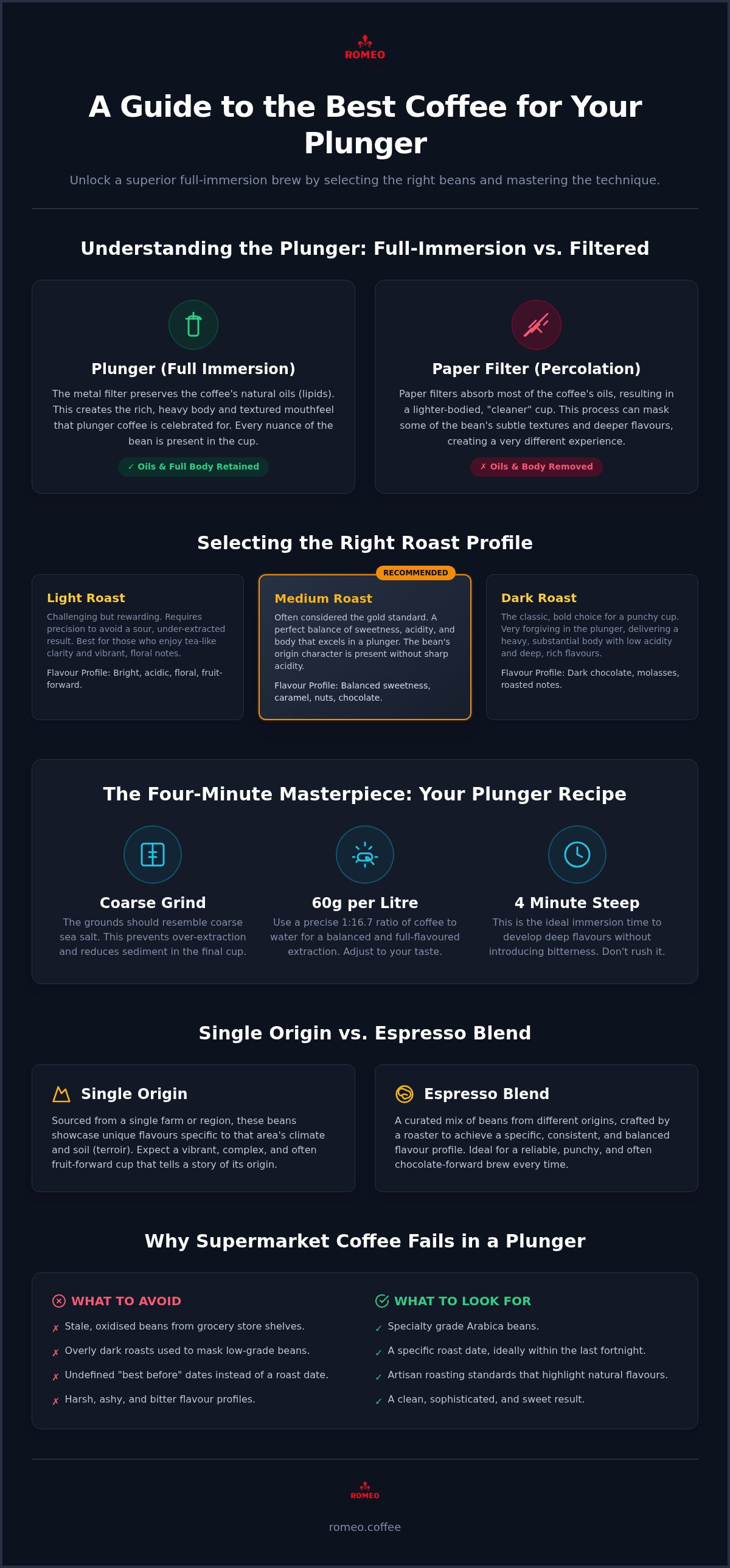
The French press, commonly known across Australia as the plunger, represents the purest form of full-immersion brewing. Unlike drip methods that rely on percolation, immersion involves saturating coffee grounds in water for the entire duration of the steep. This contact time is critical. It allows for a complete extraction of soluble solids. The absence of a paper filter ensures that the coffee's natural oils remain in the final cup. These lipids provide the heavy body and rich texture that enthusiasts demand. When searching for the best coffee beans for french press, one must consider that this method exposes every attribute of the bean. There is no filter to catch bitterness or sediment. Quality is paramount.
The Chemistry of the Plunger
Immersion brewing operates on a different kinetic scale than pour-over. In a plunger, water and coffee reach an equilibrium. Time becomes the primary variable for flavour development. Specialty coffee contains delicate aromatic compounds carried by lipids. Paper filters strip these away. In a full-immersion environment, these oils are preserved, creating a complex mouthfeel. Temperature stability is equally vital. We recommend using ceramic or double-walled steel vessels. These materials maintain a consistent heat profile during the four-minute steep. A stable temperature ensures the extraction remains uniform and avoids the sourness associated with rapid cooling.
Why Grocery Store Coffee Fails
Mass-produced coffee often falls short in a plunger. Grocery store shelves are frequently lined with stale beans that have suffered from oxidation. Oxidation destroys the volatile aromas that define a premium cup. Many commercial roasters use overly dark roasts to mask defects in low-grade green beans. In a plunger, these "burnt" notes are amplified. They result in a harsh, ashy flavour. For Australian home brewers, the roast date is the only metric of true freshness. We roast our specialty grade Arabica with meticulous precision to ensure the profile remains vibrant. Choosing the best coffee beans for french press means prioritising beans roasted within the last fortnight. Freshness is not a luxury. It is a requirement for clarity and sweetness.
Selecting the Right Roast Profile for Your Plunger
The roast profile is the blueprint. It defines the sensory experience of every immersion brew. Unlike paper-filtered methods that can soften sharp edges, the plunger highlights the roast's true character. Selecting the best coffee beans for french press requires an understanding of how heat transforms the bean. It is about matching the roast level to the extraction mechanics of the press.
Medium roasts are often considered the gold standard for this method. They offer a refined balance of sweetness, acidity, and body. Dark roasts provide the classic, bold profile that many long-term plunger users crave. Think dark chocolate, heavy molasses, and a lingering finish. Light roasts are less common in this method. They present a challenge. Yet, they reward the patient brewer with tea-like clarity and floral nuances that are otherwise lost in more aggressive brewing styles.
The Case for Medium-Dark Roasts
Medium-dark roasts excel in a plunger due to the Maillard reaction. This chemical process occurs during roasting. It develops complex sugars and creates deep, caramelised flavours. These roasts produce a rich, heavy body. It is a texture that feels substantial on the palate. Look for flavour notes of roasted hazelnuts, cocoa, and brown sugar. These beans are remarkably forgiving. The four-minute steep allows these heavier compounds to extract fully without becoming overly aggressive. For a reliable, sophisticated result, we recommend exploring our espresso coffee beans which are crafted for this specific depth.
Exploring Light Roasts in a French Press
Light roasts are high-density. They retain the specific terroir of their origin. Brewing them in a plunger requires precision. The primary risk is under-extraction. This leads to a sour, thin cup rather than a bright, acidic one. To succeed, you must adjust your variables. High-density beans often require slightly hotter water or a finer grind than their darker counterparts. When executed correctly, the reward is significant. You will experience the vibrant, fruit-forward notes of a single origin coffee. This is where the immersion method reveals its versatility. It can handle the delicate nature of high-altitude Arabica if the brewer understands How to Make French Press Coffee with technical accuracy. Consistency is the hallmark of the authoritative artisan. It is the key to identifying the best coffee beans for french press for your specific palate.
Single Origin vs. Espresso Blends: Deciding Your Flavour Path
Choosing the best coffee beans for french press requires a strategic decision. You must choose between the unique and the reliable. Single origin beans offer a window into a specific geographic location. Espresso blends provide a curated, harmonious experience. Both paths require the meticulous roasting standards we have upheld since 1999. Your choice dictates the narrative of your morning cup. It is a matter of personal priority. Do you seek the adventure of a single farm or the comfort of a masterfully balanced blend?
The Purity of Single Origin
Single origin coffee celebrates the individual farmer and the specific terroir. These beans are unblended. They capture the essence of a single harvest and a specific altitude. In a plunger, these distinct notes are amplified. You might experience the delicate jasmine florals of an Ethiopian high-altitude lot or the deep, red-berry sweetness of a Colombian specialty bean. Because the French press is an immersion method, it allows these nuances to develop slowly. Understanding the science of brewing helps one appreciate how water extracts these volatile compounds over time. It is the most honest way to taste a roaster's sourcing skill. For those seeking a specific regional character, The Home Brewer’s Guide to Single Origin Profiles offers deeper insight into our sourcing philosophy and the profiles we curate.
The Reliability of the Artisan Blend
Consistency is the hallmark of a professional roastery. Espresso blends are not merely a mix of leftover beans. They are a deliberate construction of flavour. We select specific components to balance acidity, body, and sweetness. This ensures a rounded cup that remains predictable throughout the year, regardless of harvest cycles. For many Australians, the morning ritual requires this punchy, chocolate-forward reliability. It is a steady companion. A well-crafted blend performs exceptionally well in the plunger. The immersion process highlights the synergy between the different origins, creating a mouthfeel that is both heavy and smooth. If you prefer a robust, full-bodied start to the day, consider exploring The Ultimate Guide to Espresso Beans. We apply the same artisan rigour to our blends as we do to our rarest single origins, ensuring excellence in every plunger.
Mastering the Extraction: How to Make French Press Coffee
Technical precision transforms a routine brew into a professional standard. Even the best coffee beans for french press require a disciplined approach to extraction. The plunger is not a "set and forget" device. It is a tool for controlled immersion. Achieving a heavy body without the associated bitterness requires a methodical process. Precision is the difference between a muddy cup and a masterpiece.
- Step 1: The Coarse Grind. Aim for a texture resembling sea salt. Uniformity is essential to avoid over-extraction.
- Step 2: The Ratio. Accuracy matters. Use 60g of coffee per 1 litre of water for a balanced, robust profile.
- Step 3: The Bloom. Pour enough water to saturate the grounds. Wait 30 seconds to allow carbon dioxide to escape.
- Step 4: The Steep. Fill the vessel and wait exactly four minutes. Patience ensures a complete extraction of the bean's oils.
- Step 5: The Break and Clean. Before plunging, gently stir the surface crust and skim off any floating foam. This professional tip results in a remarkably clean, silt-free cup.
The Grind: Where Most People Mess Up
Uniformity is the priority. Blade grinders produce a mix of dust and boulders, leading to an uneven and disappointing brew. A burr grinder is non-negotiable for specialty beans. It ensures every particle extracts at the same rate. Bean density also dictates your settings. High-altitude, light-roasted single origins are denser and may require a slightly finer coarse grind. If your coffee tastes unpleasantly bitter, your grind is likely too fine. If it is watery or sour, adjust to a finer setting. Consistency is the artisan's hallmark.
Water Temperature and Quality
Water quality is frequently overlooked. We recommend using filtered water to ensure the mineral content complements the coffee's profile. Temperature is equally critical. Never use boiling water. Aim for a range between 92°C and 96°C. Boiling water scorches the delicate lipids and destroys the aromatics we meticulously preserve during the roasting process. Pour with intention. A gentle stir ensures every ground is fully saturated, leading to a uniform extraction. Elevate your morning ritual by starting with our freshly roasted specialty beans, crafted for those who value technical excellence.
Sourcing Artisan Beans: The Romeo Coffee Standard
A masterclass in technique is only as effective as the material provided. To secure the best coffee beans for french press, one must look toward a roastery defined by longevity and technical rigour. Our heritage dates back to 1999. For over two decades, we have refined the artisan process to meet the highest standards of the Australian specialty market. We don't settle for commodity grade. We focus on the meticulous extraction of flavour that only high-grade specialty Arabica can provide. This commitment ensures that your morning ritual is never a compromise. Quality is our baseline. Consistency is our promise.
The Difference of Specialty Grade
Specialty coffee is defined by its score. Every bean we source must achieve an 80-point rating or higher on the standardised scale. This is not a marketing claim. It is a benchmark of physical quality and sensory complexity. In a full-immersion brew, these superior attributes are showcased without interference. We roast in small batches to maintain absolute consistency. This artisan approach allows us to monitor the development of every batch with precision. It ensures that the chocolatey depth of our espresso beans or the floral clarity of our single origin coffee is perfectly preserved. We roast to order. Freshness is guaranteed for every customer across Australia. Our streamlined delivery process ensures that premium beans arrive at your door at their peak flavour window, ready for the plunger.
Join the Romeo Community
Choosing Romeo is a statement of intent. It is a partnership in coffee excellence. By selecting artisan beans, you support the heritage of independent Australian roasters who lead the industry through craftsmanship rather than mass production. We provide more than just a product. We offer a reliable source of expertise for the home brewer who values tradition and quality. The global coffee landscape is evolving. With record global production forecast at 189.7 million bags for the 2026/27 year, the availability of high-quality lots has never been better. However, the skill remains in the selection and the roast. Elevate your daily experience by choosing beans that reflect a commitment to the craft. Explore our range of specialty coffee beans and discover the difference that twenty-five years of dedication makes in every cup.
Elevate Your Morning Ritual
Mastering the plunger requires more than just patience. It demands a synergy between technical precision and the raw quality of the bean. By prioritising a coarse, uniform grind and selecting medium to dark roast profiles, you unlock a depth of flavour that other methods simply cannot reach. Finding the best coffee beans for french press is the final step in securing a heavy-bodied, sophisticated cup that celebrates the craft of specialty coffee.
At Romeo Coffee Roaster, we have been artisan roasters since 1999. Our commitment to premium specialty grade Arabica ensures a consistent, superior result for every home brewer. We provide fast shipping across Australia, delivering freshness directly from our roastery to your kitchen. Shop our curated selection of specialty coffee beans to experience the difference of meticulous craftsmanship and decades of expertise.
Your journey toward the perfect immersion brew starts with the right foundation. We look forward to being a reliable part of your daily coffee tradition.
Frequently Asked Questions
What is the best roast level for a French press?
Finding the best coffee beans for french press involves selecting medium to dark roast levels. These roasts provide the structural body and caramelised sweetness required for full immersion. Light roasts are often too acidic and thin in a plunger unless brewed with extreme precision. A medium-dark roast ensures a balanced, rich result that highlights the natural oils of the specialty Arabica. This profile is forgiving and consistently delivers a sophisticated mouthfeel.
Can I use espresso beans in a French press?
Espresso beans are highly suitable for a plunger. These beans are typically roasted to a medium-dark level to enhance solubility and body. When selecting the best coffee beans for french press, our espresso blends offer the punchy, chocolate-forward notes that many Australians prefer. The key is the grind size. Even if the beans are intended for espresso, they must be ground coarsely to suit the immersion process.
Why does my French press coffee taste bitter?
Bitterness is usually a sign of over-extraction. This happens if your grind is too fine or your steep time is too long. Fine particles extract harsh, ashy flavours quickly. Using boiling water also scorches the delicate lipids. To fix this, use a coarse, sea-salt texture and ensure your water is between 92 and 96 degrees Celsius. Precision in these variables ensures a clean, sweet finish every time.
Do I need to buy whole beans for my plunger?
Whole beans are a requirement for those who value quality. Pre-ground coffee loses its aromatic complexity within minutes of exposure to oxygen. By grinding fresh, you ensure the volatile oils are preserved until the moment of immersion. A burr grinder is the only way to achieve the necessary uniformity. This prevents the "silt" often associated with blade grinders and maintains the high standards of an artisan brew.
How long should I steep coffee in a French press?
Four minutes is the optimal steep time for most profiles. This window allows for a thorough extraction of the bean's soluble solids without drawing out excessive bitterness. If you find the body too light, you can extend the steep to six minutes. However, this requires a very coarse grind to prevent over-extraction. Timing should be measured with a digital timer to ensure consistency in every plunger you brew.
Is single origin coffee better than a blend for immersion brewing?
Neither is objectively better; they offer different experiences. Single origin coffee is a window into a specific region's terroir, offering unique floral or fruity notes. Blends are a deliberate construction of balance and reliability. In a plunger, single origins reveal their complexity, while blends provide a heavy, comforting mouthfeel. Both options shine when you start with specialty grade beans roasted with meticulous artisan care.
How do I avoid getting silt in my coffee cup?
Silt is managed through grind quality and a simple professional tip. First, use a burr grinder to ensure particles are uniform. Second, once the four-minute steep is complete, use a spoon to break the surface crust and skim off any floating foam or fines. This "clean" step removes the particles that usually bypass the mesh filter. Plunge slowly and stop before the filter reaches the grounds.
What is the best coffee-to-water ratio for a plunger?
The ideal ratio is 60 grams of coffee per 1 litre of water. This measurement provides the necessary strength to support the heavy body of an immersion brew. For a standard 3-cup plunger, this equates to roughly 15 to 18 grams of coffee. Using a digital scale is the only way to guarantee this precision. It ensures your specialty beans are never wasted on a weak or unbalanced cup.