Decaf doesn’t have to taste like a compromise. Modern decaf coffee beans can retain the sweetness, balance and complexity that make specialty coffee worth savouring, including in a well-made espresso. Yet it’s easy to see why doubts persist: stale supermarket options and uncertainty about decaffeination methods can make a night-time cup feel like a choice between flavour and peace of mind.
Those concerns deserve clear answers. The method used to remove caffeine matters, as do the green coffee quality, roast profile and freshness after roasting. Decaffeinated beans behave differently in the roaster, so care and precision count. At Romeo Coffee Roaster, the same artisan standards applied to espresso and single origin coffees have been honed since 1999.
This guide explores how modern decaffeination preserves flavour, what to look for when weighing up processing methods, and how roast dates can help you avoid a flat cup. You’ll also find practical pointers for choosing decaf beans for home espresso and enjoying a satisfying evening brew with less caffeine. Decaf can be a considered choice for serious coffee drinkers, not a second-best substitute.
Key Takeaways
- Specialty decaf coffee beans can offer more than a caffeine reduction. Learn what careful bean selection brings to the cup.
- Compare decaffeination methods to understand how each aims to remove caffeine while preserving the coffee’s character.
- A darker, oilier appearance isn’t a freshness test on its own. Check the roast date when choosing a bag.
- Decaf may produce more fine grounds when you grind it. Adjust your espresso grind gradually and assess the extraction.
- Look beyond the label: the quality of the green beans and the care taken during roasting both shape the final flavour.
Beyond the Buzz: Why the "Death Before Decaf" Narrative is Outdated
For a generation of coffee drinkers, decaf meant a thin, bitter cup with little of the character they valued in regular coffee. That reputation didn’t come from caffeine removal alone. Commodity-grade beans, processing choices and long stretches on supermarket shelves could all leave flavour wanting. It’s understandable that some drinkers still expect less from decaf. But the category has changed.
The Problem with Commodity Decaf
Decaffeination can’t turn a modest green coffee into a complex one. When producers start with lower-grade lots, the final cup has less potential for sweetness and clarity. Some older decaf offerings were also associated with solvent-based processing, which could sound alarming to consumers and reinforce distrust. Yet a method’s name alone doesn’t tell you how a coffee tastes or whether it has been handled responsibly. Different processes work in different ways, as outlined in The Science of Extraction.
The familiar “dirty water” impression is better understood as the result of quality decisions across the supply chain, not an inevitable feature of decaf. Supermarket coffee can also sit on shelves for extended periods. Without a clear roast date, it’s harder to judge freshness, whatever the caffeine content.
The Modern Decaf Shift
Specialty producers now treat decaffeination as one part of coffee-making, not a reason to lower standards. Higher-grade Arabica selected for its cup profile gives roasters more to work with: sweetness, balance and origin character worth preserving. Some coffees are offered as traceable single origins, giving buyers more information about where the beans were grown and how they were processed.
That shift also calls for care at the roastery. Decaffeinated green beans respond differently to heat, so a considered roast profile helps develop sweetness without pushing the cup towards harshness. It’s craft, not a shortcut. A good starting point for buyers is to check the origin, processing information and roast date, rather than judging a coffee by the word “decaf” on the bag.
For Romeo Coffee Roaster, specialty coffee has been the focus since 1999. The same artisan standards applied to espresso and single origin profiles inform the approach to decaf: start with high-grade beans, then roast with precision. That makes decaf coffee beans a considered option for serious coffee drinkers, not a compromise reserved for those who’ve given up on flavour. The Australian specialty scene is making room for a more discerning cup, and the old stigma no longer tells the whole story.
The Science of Extraction: How Modern Decaffeination Preserves Flavour
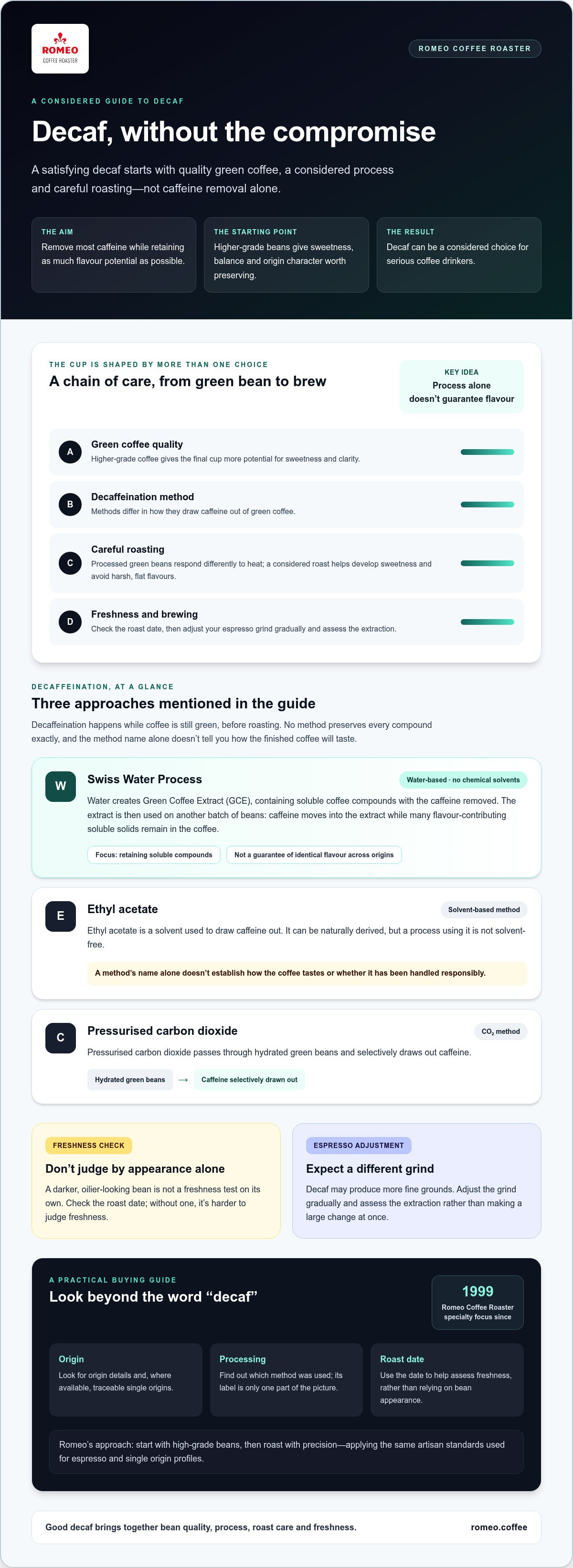
Decaffeination happens while the coffee is still green, before roasting. The aim is to remove most of the caffeine while leaving as much of the bean’s flavour potential as possible. Methods differ in what they use to draw caffeine out: water, a solvent such as ethyl acetate, or pressurised carbon dioxide. Ethyl acetate is a solvent, though it can be naturally derived; it isn’t the same as a solvent-free process. The method alone doesn’t guarantee a better cup. Bean quality and careful roasting still matter.
Decaffeination is also distinct from roasting, and no method can preserve every compound exactly. Green beans become more porous through processing, which affects how they respond to heat. Roasters need to adjust their approach to develop sweetness and avoid harsh, flat flavours. For a general overview of decaf, the National Coffee Association provides further background.
The Swiss Water Process Explained
The Swiss Water Process is a water-based method that uses no chemical solvents to remove caffeine from green coffee. First, water is used to create Green Coffee Extract (GCE), containing the coffee’s soluble compounds but with the caffeine removed. This extract is then used to process another batch of beans: caffeine moves into the extract while many flavour-contributing soluble solids remain in the coffee. It’s a measured approach, not a guarantee that every origin will taste identical after decaffeination.
For specialty coffee, that focus on retaining soluble compounds makes the process appealing. It’s often described as a gold-standard option, but the label alone doesn’t tell you how the finished coffee tastes. Ask which method was used, then look for a roast date and origin details.
The Carbon Dioxide (CO2) Method
In the CO2 method, pressurised carbon dioxide passes through hydrated green beans and selectively draws out caffeine. Under specific conditions, CO2 has an affinity for caffeine while leaving many flavour compounds in the bean. The gas can then be separated from the caffeine and reused within the process. That selectivity can help retain origin character, including the bright acidity prized in some African coffees, though the final cup also depends on the coffee itself and how it’s roasted.
CO2 processing requires specialised equipment, so it can suit larger-scale production while still being used for carefully selected coffees. Neither this method nor water processing means beans are immune to physical change. Decaffeinated beans can be more porous and brittle, so they may need a considered roast profile. The craft lies in adapting to the bean, rather than assuming it will behave like a caffeinated lot.
When assessing decaf coffee beans, treat processing as one useful part of the story, alongside origin and freshness. Romeo Coffee Roaster has applied artisan roasting standards to specialty coffee since 1999. To explore its coffee range, see Romeo’s espresso and single origin coffee.
Freshness First: Debunking the Myth of the "Stale" Decaf Bean
A decaf bean can look darker or more oily than a caffeinated bean without being over-roasted or stale. Decaffeination alters the green bean’s structure, making it more porous and changing how it responds to heat. The surface can show oils more readily, and the bean may darken differently during roasting. Appearance alone isn’t a reliable freshness test.
Identifying Fresh Decaf
Look beyond colour. Check the roast date, then smell the beans: fresh coffee should have a distinct, inviting aroma, while a flat, dusty or rancid smell can suggest it has lost its vibrancy. A best-before date gives a later-use reference, but it doesn’t tell you when the coffee was roasted. For specialty decaf, a clear roast date offers a more useful starting point.
Decaffeinated beans can lose freshness more quickly than their caffeinated counterparts because their altered, more porous structure is more exposed to the effects of air. That doesn’t mean every bag goes stale at the same rate. Roast date, packaging and storage all play a part, so judge the coffee by more than its appearance or the date printed on the front.
Optimal Storage for Decaf
Once opened, limit the beans’ contact with oxygen, light, heat and moisture. Keep them in an airtight, opaque container in a cool, dry cupboard, and avoid leaving the bag open on the bench. These simple habits help protect aroma and flavour. For a closer look at storage practices, read The Science of Freshness: How to Store Your Specialty Beans.
Freshness matters especially when you’re choosing decaf coffee beans for espresso. As coffee ages, its aroma and flavour can fade, making it harder to get the lively, sweet cup you expect. Buy a quantity you can use while it’s tasting good, seal the container after each use, and grind the beans close to brewing. A carefully developed roast can bring out sweetness and balance, but good storage helps those qualities last.
Supermarket bags don’t always make the roast date easy to find, so check the packaging before buying. If there’s only a best-before date, you may have less information about how long the coffee has been resting since roasting. A visible roast date, alongside origin and processing details, gives you a clearer picture of what’s in the bag. Dark-looking beans aren’t automatically old. Freshness is better judged by date, aroma and how the coffee performs in the cup.
Brewing Brilliance: Decaffeinated Espresso Adjustments
Decaf may need a different approach at the grinder. Processing can leave the beans more brittle, so they may break into more fine particles, or “fines”, than your usual espresso coffee. Too many fines can slow water flow and contribute to a muddy or uneven extraction. Start with a slightly coarser grind than your regular setting, then adjust in small steps.
Dialling in Your Decaf
Change one variable at a time. Keep your dose and tamp consistent, then watch how the shot flows and tastes. If it drips slowly or tastes harsh, try a coarser grind; if it runs quickly and tastes thin, move finer. Use shot time as a guide, not a target in isolation. Aim for a clear, balanced cup that brings out the coffee’s sweetness. For more espresso fundamentals, see The Ultimate Guide to Espresso Beans.
Keep your tamp level and even. Uneven compression can encourage channeling, where water finds a path through the puck and extracts some areas more than others. If your machine allows temperature adjustment, try slightly cooler water if the cup tastes overly bitter or roasty. Make a modest change and taste the result. Decaf profiles vary, so treat each adjustment as a test rather than a fixed rule.
Alternative Brewing Methods
Espresso isn’t the only way to enjoy decaf. A French Press, or plunger, uses immersion brewing and a coarser grind, which can give a rounded, full-bodied cup without the precision required for espresso. Keep the grind even and avoid leaving the coffee to steep for longer than your usual recipe. Explore the guide to coffee beans for French Press for more on choosing beans for this method.
For pour-over, a bed clogged with fines can drain slowly and taste muddy. Use a slightly coarser grind, pour steadily and avoid disturbing the grounds more than necessary. If the brew stalls, adjust the grind before changing several parts of your recipe at once.
Small, measured adjustments make decaf easier to dial in. Explore Romeo’s espresso coffee beans to find a roast suited to your home espresso routine.
The Romeo Standard: Sourcing Specialty Decaf Without Compromise
Decaf deserves the same attention as any espresso or single origin coffee. Romeo Coffee Roaster has roasted specialty coffee since 1999, building experience across a range of coffee profiles. That heritage informs its approach to decaf: choose high-grade beans and roast with precision, rather than treating caffeine removal as a reason to lower expectations.
Selection begins with potential in the green coffee. A blind cupping can help assess a coffee’s aroma, sweetness, acidity and balance without expectations about its origin or label. It’s a useful quality-control approach across specialty coffee. The key is to judge the cup on its merits, then consider how roasting can bring forward its best qualities.
Artisan Roasting Techniques
Decaffeinated beans are more porous and can respond differently to heat than conventional green coffee. Roasting calls for care: the profile needs to develop sweetness and structure without pushing the beans towards burnt, carbon-like notes. Precision matters at each stage. Romeo applies the same artisan standards to decaf as to its espresso blends, with the aim of a balanced, satisfying cup.
Romeo’s national wholesale coffee supply standards also inform its retail bags. That connects its wider coffee expertise with the quality expected in a home brew, without making decaf a separate, lesser category.
Your New Daily Ritual
If you’re moderating caffeine, decaf can make room for another enjoyable cup without giving up the ritual or the pleasure of espresso. It may suit an afternoon pause or an evening brew, though decaf isn’t necessarily caffeine-free. What matters is choosing a coffee with flavour and roast care you’d value at any time of day.
Good decaf isn’t defined by what’s missing. It’s defined by what remains in the cup: sweetness, balance and a character worth returning to. Explore current specialty decaf coffee beans and find a considered alternative for your next espresso.
Make Your Next Cup a Decaf Worth Savouring
Great decaf is shaped by more than caffeine removal. Bean quality, processing, a careful roast and freshness all contribute to flavour, while small brewing adjustments can help bring out the best in your espresso. A darker or oilier appearance isn’t proof that beans are stale, so check the roast date and trust your senses.
Choosing decaf coffee beans can be a deliberate choice for coffee lovers who want to enjoy the ritual with less caffeine. Romeo Coffee Roaster has been roasting specialty coffee since 1999, applying artisan standards to decaf as well as espresso and single origin profiles. The result is an approach that treats decaf as coffee to savour, not a compromise.
Ready to try a considered decaf for your next cup? Shop artisan-roasted decaf coffee beans and discover a new part of your coffee ritual.
Keep exploring, adjust your brew to suit the beans, and make room for a satisfying cup whenever it suits you.
Frequently Asked Questions
Is decaf coffee completely caffeine-free?
No. Decaffeinated coffee usually retains a small amount of caffeine, and the amount varies with the beans, serving size and brewing method. Decaf is better understood as lower-caffeine coffee, not caffeine-free coffee. If you’re avoiding caffeine for a medical reason or are particularly sensitive to it, check the product information and discuss suitable choices with a health professional.
Are chemicals used to make decaf coffee beans?
Some decaffeination methods use solvents, while others use water or carbon dioxide to extract caffeine. Ethyl acetate is one solvent used in decaffeination; the Swiss Water Process uses water, and the CO2 method uses carbon dioxide. The method depends on the coffee and producer. Check the packaging or ask the roaster which process was used if you want to know how a particular coffee was decaffeinated.
Why does decaf coffee often taste different?
Decaf can taste different because the bean has undergone an additional process before roasting, and decaffeinated beans respond differently to heat. The green coffee’s quality, origin and roast profile also shape the flavour. Lower-grade beans or a roast that doesn’t suit the coffee may produce a flat or harsh cup. Specialty decaf starts with careful bean selection and roasting that aims to retain sweetness and character.
Can I use decaf coffee beans in my espresso machine?
Yes. You can use decaf in an espresso machine, though you may need to adjust your grind. Decaffeinated beans can be more brittle and produce extra fine particles, so try starting slightly coarser than your usual setting. Keep your dose and tamp consistent, then adjust the grind in small steps. Judge the shot by its flow and flavour, not time alone.
How should I store my decaf coffee beans to keep them fresh?
Store decaf in an airtight, opaque container in a cool, dry place, away from heat, light and moisture. These conditions help protect the beans’ aroma and flavour. Check the roast date when buying, as a best-before date doesn’t show when the coffee was roasted. After opening the bag, reseal it promptly and grind only what you need for each brew.
Does decaf coffee have the same health benefits as regular coffee?
Decaf retains many of coffee’s flavour compounds, but it contains less caffeine, so it won’t have the same stimulant effect as regular coffee. Health effects can vary between people and depend on factors such as individual sensitivity and how much coffee they drink. It’s best not to treat decaf as having identical effects or as a health treatment. Ask a health professional about personal concerns.
Which decaffeination process is the best for flavour?
There isn’t one process that guarantees the best flavour in every coffee. The Swiss Water Process uses water to extract caffeine, while the CO2 method uses carbon dioxide; other processes use solvents such as ethyl acetate. Bean quality, origin and roast profile also influence the cup. If a particular method matters to you, check the coffee’s processing details and assess the flavour for yourself.
Why are decaf beans often oilier than regular beans?
Decaffeination changes the structure of green coffee beans, making them more porous. After roasting, oils may be more visible on the surface, so decaf can look darker or shinier than regular coffee at a similar roast level. That appearance alone doesn’t prove the beans are stale or over-roasted. Check the roast date and aroma, then taste the coffee to judge its freshness and character.