What if the difference between an ordinary cup and a distinctive one begins long before brewing? A search for “coffee speciality coffee” can bring up plenty of labels, but not always a clear explanation of what they mean.
Origin, processing and roast descriptions can sound like marketing language when their connection to flavour isn’t clear. Specialty coffee has a more practical meaning: it refers to quality assessed against recognised standards, alongside careful decisions at each stage from green bean to brewed cup. No single label tells the whole story.
This guide explains what specialty coffee means, how quality is assessed and where the term has its limits. You’ll see how origin, processing, roasting and brewing shape flavour, and learn to read coffee descriptions with more confidence. We’ll also look at how espresso and single origin coffees offer different ways to explore a coffee’s character, so you can choose according to your own taste.
Key Takeaways
- Learn what the term coffee speciality coffee means, and why quality involves more than a label.
- Trace how cultivation, processing, roasting and brewing can shape a coffee’s character.
- Understand how cupping assesses coffee, while recognising that personal taste still matters.
- Use origin, processing, roast date and brew-style details to choose coffees more confidently.
- Explore specialty espresso and single origin beans from Romeo Coffee Roaster, an independent artisan roastery founded in 1999.
What is specialty coffee, and what makes it different?
Specialty coffee is recognised for quality through assessment of its beans and brewed cup, supported by careful handling from cultivation to brewing. It’s a quality-led category, not simply an elevated-sounding word on a bag. The green coffee matters, as do the choices made during processing, roasting and preparation.
That journey helps explain why specialty coffee isn’t one roast level, flavour profile or brewing method. It can be roasted for espresso or prepared as filter coffee. One cup may be chocolatey and full-bodied; another may be floral and bright. Neither style defines the category. If you’ve searched “coffee speciality coffee”, look beyond the phrase to the information and quality assessment behind it.
How is specialty coffee defined?
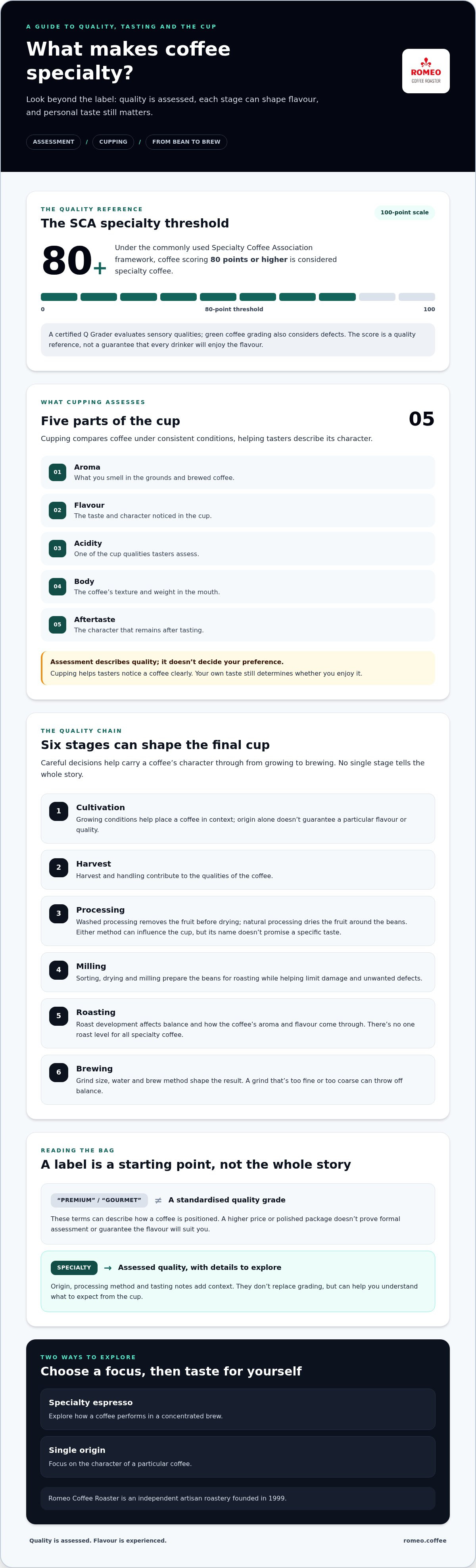
Formal assessment gives the term more substance. Under the commonly used Specialty Coffee Association (SCA) framework, coffee scoring 80 points or higher on a 100-point scale is considered specialty coffee. A certified Q Grader evaluates the sample’s sensory qualities. Green coffee grading also considers defects. The score provides a quality reference, but it can’t guarantee that every drinker will enjoy the flavour.
A bag that simply says “specialty” doesn’t explain how the coffee was assessed. Look for details such as origin, processing method and tasting notes. These don’t replace grading, but they help you understand what to expect from the cup. For more context on the term and its development, see Specialty Coffee Definition and History.
Is specialty coffee the same as premium or gourmet coffee?
Not necessarily. “Premium” and “gourmet” can describe how a coffee is positioned, but they aren’t standardised quality grades by themselves. A higher price or polished package may signal a particular brand experience, but neither proves that the beans have been formally evaluated or that the brewed coffee will suit your taste.
Consider two bags. One calls itself “gourmet” and gives little detail; the other names its origin and process and explains that its quality has been assessed. The first uses descriptive language. The second gives you more information to consider, though you’ll still need to taste the coffee to decide whether its character suits you.
That’s the useful distinction: specialty points to assessed quality, while a label alone is only a claim. The full picture comes from the coffee and the care applied at each stage.
How specialty coffee moves from producer to brewed cup
A quality cup is the result of a chain of decisions, not a single finishing touch. Each stage, from cultivation and harvest to processing, milling, roasting and brewing, can influence what you taste. Careful handling can preserve a coffee’s desirable qualities, but it can’t make every batch or cup identical.
What do origin and processing tell you about a coffee?
Coffee grows as a fruit. Its seeds are processed, dried and prepared for export before roasting. In this unroasted state, the beans are called green coffee. Details such as country, region or farm place the coffee in context, but don’t guarantee a particular flavour or quality. Growing conditions, harvest and handling all play a part.
Processing describes what happens to the fruit and seeds after harvest. In a washed process, the fruit is removed before the beans are dried. In a natural process, the fruit dries around the beans. Other approaches also exist. Each method can influence the cup, but its name alone doesn’t promise a specific taste. Careful sorting, drying and milling prepare the beans for roasting while helping limit damage and unwanted defects.
Why do roasting and brewing matter?
Roasting develops the green coffee’s aroma and flavour. Roast development affects balance and how the coffee’s qualities come through. A skilled roast can reveal what’s already there, but it can’t create excellent raw material on its own. There’s no single correct roast level for all specialty coffee. The choice depends on the coffee and how it’s intended to be enjoyed.
Brewing completes the chain. Grind size affects how quickly water extracts flavour, while water and brew method also shape the result. A grind that’s too fine or too coarse can throw off balance, even with well-roasted beans. If a cup tastes too sharp, flat or bitter for your liking, adjust the grind or recipe and taste again.
Specialty espresso beans let you explore how coffee performs in a concentrated brew, while single origin beans put the focus on the character of a particular coffee. Romeo Coffee Roaster, an independent artisan roastery founded in 1999, produces both. Explore specialty espresso and single origin beans.
From growing conditions to grind size, every stage can shape the final cup. Careful choices help carry the coffee’s character through. For anyone searching “coffee speciality coffee”, that quality chain is the useful idea: the cup reflects both the coffee and the care taken along the way.
How specialty coffee quality is assessed beyond the label
A label can introduce a coffee, but sensory assessment gives you a closer look at what’s in the cup. Cupping is a structured tasting used to compare coffee’s aroma, flavour, acidity, body and aftertaste under consistent conditions. It helps tasters describe a coffee’s qualities, but it doesn’t determine whether you’ll enjoy it.
What happens during coffee cupping?
During cupping, coffees are prepared using a consistent method so tasters can compare them with fewer variables. They assess the aroma of the grounds and brewed coffee, then taste for flavour, balance and texture. The aim is to notice the coffee clearly, rather than disguise its character with milk, sweeteners or a particular brewing style.
The terms are straightforward. Aroma is what you smell. Acidity describes a lively, bright quality, not necessarily sourness. Body is the coffee’s weight or texture on the palate. The finish is the flavour and sensation that remain after swallowing. Together, these observations give a fuller picture than one tasting note.
Do tasting notes guarantee what you will taste?
No. Notes such as citrus, cocoa or stone fruit are sensory descriptions, not added ingredients or exact promises. They suggest a coffee’s character, but your impression can change with grind size, water, brew method and personal palate. A coffee described as bright may taste pleasantly lively to one person and too sharp to another.
Formal evaluation and personal preference answer different questions. Assessment considers qualities such as clarity, balance and notable defects. Your own taste decides whether you’d choose that cup again. A well-regarded coffee doesn’t have to match every drinker’s preferred style.
| Structured quality cues | Personal taste preferences |
|---|---|
| Aroma, flavour clarity, balance, acidity, body and finish | Whether you enjoy floral, fruity, chocolatey, bright or mellow flavours |
| Considered through consistent tasting conditions | Shaped by palate, preparation and how you like to drink coffee |
Use tasting notes as a guide, then let your own cup have the final word. A label or flavour description can’t replace careful evaluation or your own experience. Notice what you enjoy and use those preferences to guide what you try next.
How to recognise specialty coffee and find a profile you enjoy
Choosing a coffee is easier when you treat the bag as a guide, then let the cup confirm what you like. Start with the description, match the coffee to your brew method, then taste and adjust your recipe if needed. This sequence turns unfamiliar terms into useful clues, not rules about what you should enjoy.
Which details on a coffee bag are worth reading?
Origin tells you where the coffee was grown, while processing describes how the beans were handled after harvest. Both add context, but neither guarantees a particular flavour. Tasting notes such as citrus, cocoa or florals suggest possible impressions rather than exact outcomes.
Look for the roast date where it’s provided. It tells you when the beans were roasted and can help you make sense of freshness. Keep beans sealed in an airtight container, away from heat, light and moisture. Check the bag for a suggested brewing style, too. Espresso-focused beans are developed with espresso preparation in mind, while other coffees may be described for filter brewing. These are useful starting points, not limits on how you can brew a coffee.
If you’re exploring what’s shaping coffee choices, read our guide to coffee bean trends in 2026. For a closer look at espresso-specific choices, see our guide to espresso beans. The exact phrase “coffee speciality coffee” may be how you search, but a useful description gives you more to work with than a label alone.
How can you develop your own coffee palate?
Keep tasting simple. If you can, compare two coffees brewed in the same way. Notice their aroma, texture, acidity and finish. You don’t need specialist vocabulary. “Light and citrusy” or “rounded with a cocoa-like finish” is enough to record what stands out.
Then change one brewing variable at a time. For example, adjust the grind while keeping the water and method consistent. If the cup changes, you’ll have a clearer idea of what caused it. Espresso drinkers can explore coffees suited to that style, while filter drinkers can follow their own preferences. Neither method defines quality. Curiosity matters more than finding a supposedly correct palate.
Ready to put those preferences into practice? Explore Romeo’s espresso and single origin coffee beans as you find the profiles and brewing styles that suit you.
How Romeo Coffee Roaster approaches specialty coffee
Romeo Coffee Roaster is an independent artisan roastery founded in 1999. Its specialty espresso and single origin beans offer two practical ways to explore coffee: espresso beans are made for that concentrated brew, while single origin coffees put the focus on the character of an individual coffee.
Specialty coffee isn’t defined by roasting alone. Roasting works with the qualities present in the green coffee, and choices at this stage influence how those qualities come through and how the beans suit their intended use. A roast can shape a coffee’s balance and aroma, but it can’t substitute for quality earlier in the chain or guarantee that every drinker will prefer the result.
What can a roastery contribute to the quality chain?
Roasting is a point of interpretation. The roaster develops a profile to work with the coffee and its intended preparation, whether that’s espresso or another brew style. The same coffee can express itself differently depending on the roast and how it’s prepared.
Romeo’s history provides context for that craft. Founded in 1999, the roastery produces specialty espresso and single origin beans. Experience alone doesn’t tell you exactly how a coffee will taste, but clear descriptions and attention to the cup can help you make an informed choice. For readers searching “coffee speciality coffee”, the useful question is not only where a coffee comes from, but how each stage contributes to the final brew.
Where can you continue exploring specialty coffee?
Start with the style you enjoy. Espresso beans let you explore how coffee performs in a concentrated brew. Single origin beans offer another route, with origin details that help you compare different coffees. Neither is a measure of quality by itself. Both can help you notice which flavours, textures and brewing styles suit your palate.
Romeo supplies retail customers and wholesale partners across Australia. If you’re comparing coffee choices, the guide to decaf coffee beans can help you understand that option alongside espresso and single origin coffees.
Keep your own preferences in view as you explore. Note the coffee’s description, brew it with care and pay attention to what you enjoy. Explore Romeo’s specialty coffee range.
Take your next cup further
Specialty coffee is more than a label. Its quality reflects choices made from cultivation through to brewing, while structured tasting helps describe the cup without dictating what you should enjoy. Origin, processing and tasting notes offer useful clues, but your own palate has the final say.
That’s the practical answer to “coffee speciality coffee”: look for meaningful detail, choose beans suited to your preferred brew method, then taste and adjust. Curiosity can make unfamiliar descriptions easier to understand and help you find coffees you genuinely enjoy.
Romeo Coffee Roaster is an independent artisan roastery founded in 1999, producing specialty espresso and single origin coffee beans for retail customers and wholesale partners across Australia. Explore Romeo Coffee Roaster’s specialty coffee range and choose a coffee to try next.
Start with a style that appeals, brew it with care and see what you discover. Your next favourite cup may be closer than you think.
Frequently Asked Questions
What is specialty coffee?
Specialty coffee is coffee recognised for quality through assessment of its beans and cup, alongside care at each stage from growing to brewing. The phrase “coffee speciality coffee” may appear in searches, but the label alone doesn’t establish quality. Look for details such as origin, processing and tasting notes, then judge the brewed cup for yourself. Specialty coffee varies widely in flavour and isn’t defined by one roast or brew style.
Is specialty coffee better than regular coffee?
Specialty coffee is assessed against quality criteria, but “better” depends partly on what you enjoy drinking. You might prefer a familiar darker roast to a more delicate, fruit-forward cup, even if the latter receives a stronger formal evaluation. Think of quality assessment as a way to understand a coffee’s condition and sensory qualities, not as a ranking of personal taste. The best choice is one you enjoy, prepared in a way that suits it.
How is specialty coffee graded?
Under the commonly used Specialty Coffee Association framework, coffee scoring 80 points or higher on its 100-point scale is considered specialty coffee. A certified Q Grader assesses a sample’s sensory qualities, while green coffee grading also considers defects. The score gives a structured quality reference; it doesn’t promise that every brewed cup will be identical or appeal to every palate. Roast, brewing and personal preference still shape the drinking experience.
Does specialty coffee have to be Arabica?
No. Specialty coffee isn’t defined solely by the species of coffee plant. Arabica is common in specialty offerings, but the species name by itself doesn’t tell you how carefully the coffee was grown, processed or evaluated. Other species, including robusta, can also be produced and assessed for quality. Look for clear information about the coffee and how its quality is described rather than treating “Arabica” as a guarantee of a superior cup.
What does single origin mean in specialty coffee?
Single origin means the coffee comes from one stated origin, which may refer to a country, region, farm or other defined source, depending on how the roaster describes it. It gives you context and can make it easier to compare different coffees. The term alone doesn’t guarantee a particular flavour or quality. Read it alongside processing and tasting notes, then use your own cup to decide what you enjoy.
How should I choose specialty coffee for espresso?
Start with beans described for espresso, then consider the flavour notes you tend to enjoy. Cocoa or nut notes may suit those seeking a familiar, rounded profile; fruitier or brighter notes offer a different expression. Use the roaster’s suggested style as a starting point, not a fixed rule. At home, adjust grind size one step at a time and taste the result. Romeo Coffee Roaster produces specialty espresso beans for retail customers and wholesale partners across Australia.