
A genuine piccolo coffee is not a shrunken latte. It is a precise, deliberate espresso study designed to showcase origin character rather than drown it in warm dairy. Yet, standing at the espresso machine, it is easy to see why confusion reigns. Between the cortado, the traditional macchiato, and the flat white, the lines blur quickly. Even worse, steaming silky microfoam inside a tiny 100ml glass pitcher often leaves you with stiff, separated foam that overpowers the delicate tasting notes of your beans.
You already know that great coffee relies on rigorous balance. When dialled in correctly, this compact drink offers the ultimate expression of craft: punchy espresso clarity tempered by a whisper of textured sweetness. In this guide, you will master the exact shot yields and brew ratios needed to pull an authentic cup at home, alongside professional steaming techniques tailored for minimal milk volumes. Here is how to select the right roast profiles, control your extractions, and pour a pristine piccolo every single morning.
Key Takeaways
- Understand the precise anatomy of an authentic piccolo coffee, combining a rich ristretto with velvety steamed milk in a 100ml glass.
- Dial in strict 1:1 to 1:1.5 extraction ratios to capture dense sweetness without introducing astringency or bitter over-extraction.
- Distinguish between a piccolo, cortado, and macchiato based on true liquid volume, milk texture, and coffee concentration.
- Master steaming techniques for smaller milk volumes to produce glossy microfoam that integrates seamlessly rather than separating into dry foam.
- Choose high-grade espresso beans and single origin roasts that deliver vibrant origin character without being smothered by milk.
What Is a Piccolo Coffee? Origins, Definitions, and Common Myths
Dismissing a piccolo coffee as merely a miniature latte misses its entire architectural purpose. A true piccolo consists of a single restricted extraction, or ristretto, finished with warm, silky textured milk in a small vessel. Unlike larger cafe serves that submerge coffee character under a sea of dairy, this drink maintains an assertive espresso profile. It delivers the textural luxury of microfoam while preserving the nuanced aromatics of the roast.
The drink emerged directly from Australian cafe culture. Roasters and baristas needed a practical vehicle to evaluate how their espresso cuts bound with warm dairy across busy service shifts. Drinking ten full-sized flat whites or standard lattes led straight to palate exhaustion and excessive dairy consumption. The piccolo solved this operational dilemma. It created an efficient, highly focused tasting format that showcased balance, sweetness, and bean provenance without unnecessary liquid volume.
The Anatomy of an Authentic Piccolo Latte
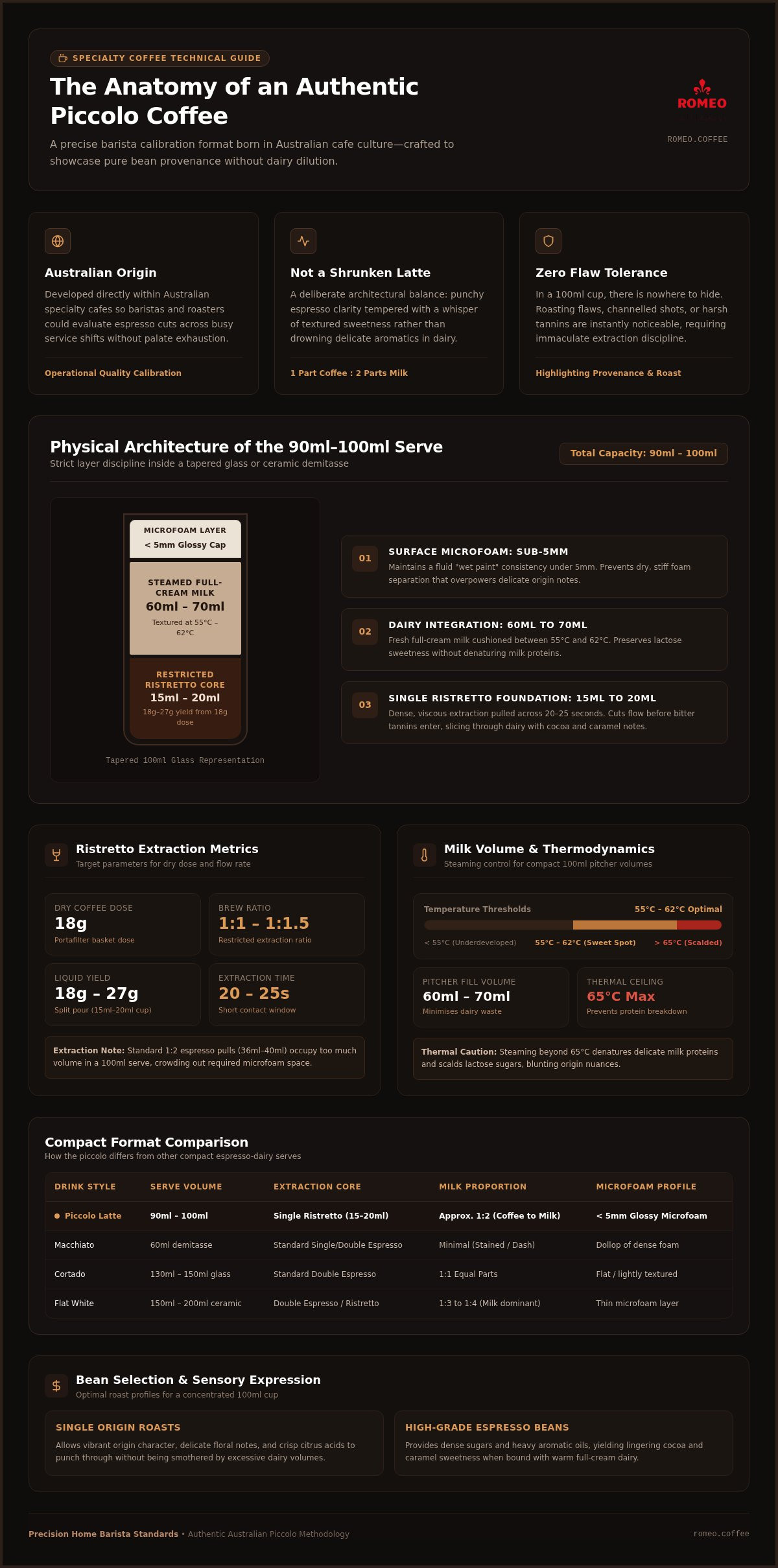
Precision defines the build. While other coffee drinks allow generous room for interpretation, an authentic piccolo latte adheres to strict physical boundaries:
- Vessel size: Served strictly within a 90ml to 100ml tapered glass or ceramic demitasse.
- Core ratio: One part concentrated coffee extraction to roughly two parts lightly textured milk.
- Surface texture: Capped with a thin, glossy layer of microfoam, typically under five millimetres.
The resulting dynamic keeps milk sweetness in a supporting role. It cushions the extraction without blunting its impact.
Why Baristas Champion the Piccolo Format
Specialty coffee leaves nowhere to hide in a 100ml serve. In a 250ml cup, excessive milk can easily mask roasting flaws, hollow extraction channels, or astringent taints. A piccolo demands absolute cleanliness in both green sourcing and roast development.
Baristas gravitate toward this compact cup for morning calibrations. It provides an immediate audit of bean development, letting delicate floral or citrus notes shine through while confirming the milk's complementary mouthfeel. The balance must be exact. Flawed beans yield a biting, harsh cup; immaculate single origin coffee or precision-crafted espresso beans create a harmonious, punchy revelation.
Deconstructing the Piccolo: Ratios, Extraction, and Milk Volume
Vague brewing guidelines often reduce a piccolo coffee to an arbitrary dash of milk over espresso. That approach fails on the palate. A balanced cup requires mathematical precision across grind distribution, dry dose weight, and liquid output. When mastering how to make a piccolo latte, precision takes priority over guesswork. In a 100ml cup, an error of just five millilitres fundamentally changes the tactile balance.
The architecture relies on a restricted brew ratio ranging between 1:1 and 1:1.5. If you dose 18 grams of dry coffee into your portafilter basket, your liquid target should sit between 18 and 27 grams across a split pour, yielding roughly 15ml to 20ml in your glass. This dense, viscous core provides the ideal foundation for rich, chocolate-forward espresso beans, slicing through the dairy to impart lingering cocoa and caramel sweetness.
The Espresso Foundation: Single Shot vs Single Ristretto
Using a standard 1:2 espresso extraction will compromise your piccolo. Pulling 36ml to 40ml of liquid coffee occupies too much space in a 100ml glass, leaving insufficient room for milk to integrate properly.
A true ristretto cuts the flow before bitter compounds and excessive water dilute the cup. Aim for an extraction window of 20 to 25 seconds. This short contact time extracts volatile oils, fruit acids, and dense sugars while leaving harsh tannins behind in the puck.
Calibrating Milk Volume and Temperature
Liquid balance shifts instantly with poor milk management. A classic piccolo demands careful temperature calibration:
- Liquid volume: Steam roughly 60ml to 70ml of fresh, full-cream dairy. This allows adequate displacement in a 90ml to 100ml vessel.
- Thermal ceiling: Restrict your steaming temperature between 55°C and 62°C.
- Microfoam density: Maintain a fluid, wet paint consistency. Thick foam creates a harsh separation of layers.
Exceeding 65°C denatures delicate milk proteins and scalds lactose sugars, masking origin nuances. For an elevated morning ritual, pair this disciplined technique with freshly roasted beans from romeo.coffee to experience how meticulous roasting elevates compact brews.
Piccolo vs Macchiato, Cortado, and Flat White: Key Differences
Ordering or brewing short milk drinks often feels like navigating a minefield of conflicting definitions. Cafes frequently mislabel these beverages, treating them as interchangeable names for small cups. They are not. Each format relies on distinct coffee-to-milk ratios, specific milk textures, and specialised glassware that fundamentally shape flavour release and heat retention on the palate.
Understanding these mechanical variations eliminates guesswork at the espresso bar. It ensures your morning brew delivers the exact tactile weight you desire.
Piccolo vs Macchiato: Foam Structure and Fluid Volume
The distinction between these two comes down to fluid mechanics:
- Traditional espresso macchiato: A single or double espresso merely "marked" with a dense dollop of spooned milk foam. It contains virtually no liquid dairy. The palate experiences an immediate, punchy hit of espresso bitterness tempered slightly by airy foam.
- Piccolo coffee: Fully integrated liquid milk and espresso. The microfoam is folded seamlessly throughout the drink, creating a velvety, cohesive texture from the first sip to the last.
Piccolo vs Cortado: Spanish Heritage vs Modern Coffee Culture
Many cafes treat these two styles as identical twins, but looking closely at the difference between a piccolo and cortado reveals distinct brewing lineages and physical structures. Originating in Spain, the cortado uses a 1:1 ratio. It cuts a full double shot of standard espresso with an equal volume of warm, barely textured steamed milk, traditionally presented in a heavy-faceted Gibraltar glass.
In contrast, a piccolo coffee utilises a concentrated ristretto base paired with roughly two parts of silky, highly aerated microfoam. The cortado is flatter and denser; the piccolo is sweeter, brighter, and texturally refined.
Piccolo vs Flat White: Intensity and Dilution Factors
The flat white represents Australia's global gift to coffee culture, yet it serves an entirely different drinking occasion. A standard flat white sits comfortably between 150ml and 180ml, combining a double espresso with textured milk. While the microfoam texture mirrors a piccolo, the sheer volume of dairy inevitably dilutes the punch of the roast.
A piccolo delivers that identical glossy mouthfeel without the high dairy load. It suits coffee drinkers who crave silky texture but refuse to compromise on raw espresso intensity.
How to Make a Piccolo Coffee at Home: Step-by-Step Barista Method
Executing an exceptional piccolo coffee on domestic equipment requires deliberate mechanical control. Home machines feature smaller boilers and distinct steam pressure dynamics compared to multi-boiler commercial units. When dealing with roughly 70ml of milk, errors happen in split seconds. Consistent preparation turns volatile variables into repeatable results.
Approach every stage with methodical care. Cleanliness, dose accuracy, and precise milk texturing separate a muddy beverage from a refined, structured cup.
Preparing the Puck and Pulling the Shot
Everything starts at the grinder. Set your burrs finer than your standard espresso profile to restrict the flow rate and yield 15ml to 20ml of liquid coffee in 20 to 25 seconds.
- Dosing: Weigh your dry dose precisely into a dry, pre-heated portafilter basket.
- Distribution: Use a needle distribution tool (WDT) to break clumps and eliminate micro-channels. Uneven density ruins restricted extractions instantly.
- Tamping: Apply level, steady pressure. A flat bed guarantees uniform water contact throughout the puck.
- Extraction: Lock the portafilter in immediately and pull the shot directly into a pre-warmed 100ml glass.
Mastering Microfoam in Small Pitchers
Steaming minimal dairy volume presents the steepest learning curve at home. A large 600ml jug disperses steam wand velocity poorly, resulting in coarse froth. Switch to a compact 300ml pitcher filled with fresh, chilled dairy just below the spout indentation.
Submerge the steam tip slightly off-centre. Open the steam valve completely, introducing air with a subtle hiss for no longer than two seconds. Submerge the tip just half a centimetre to draw the liquid into a fast, rolling whirlpool. This vortex breaks large bubbles into dense, reflective microfoam before the milk overheats. Shut the steam off at 60°C. Tap the base firmly against the counter and swirl the pitcher until the surface resembles gloss paint.
The Pour: Integrating Milk and Crema
Pouring technique dictates your final flavour balance. Tilt your 100ml glass at roughly 45 degrees. Begin pouring from five centimetres above the rim with a thin, steady stream aimed into the deepest section of the crema. This initial velocity pierces the coffee surface, mixing the warm liquid milk beneath while protecting the aromatic golden crema on top.
As the liquid level nears the brim, level the glass and lower the pitcher spout close to the surface. Increase the pour rate slightly to deposit a silky, fine ribbon of microfoam across the top. To secure the freshest beans roasted specifically for balanced home extractions, order premium espresso coffee beans directly to your doorstep.
Selecting the Best Coffee Beans for a Balanced Piccolo
Every defect reveals itself in a low-volume cup. While a large morning latte easily conceals astringency or scorching beneath 200ml of warm milk, a piccolo coffee leaves the extraction bare. The restricted milk volume acts as a magnifying lens. High-grade Arabica beans, roasted with absolute consistency, are essential to achieve sweetness without sharp bitterness.
Dialling in your beans means matching the solubility of your roast to the short extraction window of a ristretto. When you balance roast development with milk volume, the result is dense, syrupy, and vibrant.
Why Roast Profile Matters in Low-Volume Milk Drinks
Roast depth determines how the coffee oils interact with dairy proteins. Selecting the right roast profile makes the difference between harmonious sweetness and aggressive pungency:
- Dark, oily roasts: Heavy roasts impart intense ash and carbon notes. In a 100ml drink, these heavy pyrolytic compounds completely overwhelm the gentle sweetness of steamed milk.
- Under-developed light roasts: Roasts designed purely for filter extractions carry sharp malic and citric acidity. When combined with warm dairy in low ratios, these unchecked acids create a sour, curdled sensation on the tongue.
- Artisan medium roasts: The ideal sweet spot. A balanced medium profile caramelises raw sucrose, yielding rich milk chocolate, toasted hazelnut, and dark toffee flavours that bind cleanly with microfoam.
Single Origin Coffee vs Espresso Blends for Piccolos
Selecting between single lots and blends comes down to personal taste. A thoughtfully constructed espresso blend delivers dependable body, crema thickness, and round cocoa notes that hold their own morning after morning.
Single origin coffee, however, elevates the piccolo into a focused tasting experience. Naturally processed lots introduce layered berry jam and stone-fruit aromatics that turn the drink into a decadent, fruit-forward dessert. Clean washed coffees provide a bright floral elegance that cuts through rich dairy without clashing. Choosing specialty beans ensures every sip delivers crisp regional identity.
Sourcing Specialty Freshness
Resting your coffee correctly ensures optimal extraction stability. Freshly roasted coffee contains trapped carbon dioxide gas that disrupts even water flow during restricted shots. Let your beans rest for five to fourteen days post-roast before dialling them in. Keep them sealed in an opaque, airtight container in a cool, dry pantry away from ambient heat.
Quality begins at the roaster. Sourcing freshly roasted batches from Romeo Coffee Roaster guarantees access to carefully developed, defect-free specialty beans roasted to unlock remarkable depth in your cup.
Mastering the Craft in Every Cup
Brewing an authentic piccolo coffee comes down to discipline and respect for proportion. By pairing a restricted ristretto extraction with precisely steamed, silky microfoam in a 100ml glass, you preserve the natural sweetness and terroir of your coffee without drowning it in dairy. When you master these tight parameters at home, every morning pour becomes an uncompromising celebration of craft.
Yet exceptional technique relies entirely on the quality of your foundation. Because short milk drinks expose every nuance in the cup, using clean, defect-free beans is essential. Romeo Coffee Roaster has been mastering roasting profiles since 1999, supplying direct national delivery across Australia. Whether you prefer vibrant single origin coffee or rich, chocolate-forward espresso coffee beans, fresh roasts make all the difference on your palate. Elevate your home brew with freshly roasted specialty beans from Romeo Coffee Roaster and experience true espresso clarity today.
Frequently Asked Questions
Is a piccolo coffee stronger than a standard latte?
A piccolo coffee tastes considerably stronger on the palate due to its concentrated coffee-to-milk ratio. While a standard latte dilutes espresso across roughly 200ml to 250ml of milk, a piccolo uses a restricted ristretto cut inside a compact 100ml serve. Total caffeine content remains lower or equal because it utilises a single extraction, but sensory impact and perceived intensity are substantially higher.
How many calories are in a typical piccolo coffee?
A standard piccolo prepared with full-cream cows milk contains approximately 40 to 45 calories. Because the beverage requires only 60ml to 70ml of steamed dairy, the caloric load remains minimal compared to a large latte or cappuccino, which often exceeds 150 calories. Opting for skim milk or unsweetened almond milk reduces the count further to roughly 20 to 25 calories per cup.
Can I use plant-based milk alternatives for a piccolo coffee?
You can use plant-based milks, provided you select specialised barista formulations. Standard supermarket plant milks often split when exposed to the high acidity of a concentrated ristretto. Barista-grade oat milk and soy milk contain added stabilisers and lipids that endure rapid steaming in small pitchers, creating the elastic microfoam required to integrate smoothly beneath the espresso crema.
What is the correct size glass for serving a piccolo?
The correct service vessel is a tapered glass tumbler with a capacity between 90ml and 100ml. Flared or conical glassware directs the aromatics toward the nose while maintaining thermal mass. Using larger ceramic cups ruins the proper 1:2 extraction ratio, leaving you with either excess air space or an over-diluted drink that loses its signature punch.
Why does my piccolo coffee taste sour?
Sourness indicates under-extraction or excessive roasting acidity. If your water passes through the puck too quickly, you extract only the sharp organic acids while missing the balancing sugars. Grind your coffee beans finer to extend extraction time to 20 to 25 seconds. Alternatively, swap out under-developed light roasts for an artisan medium-roast espresso blend that delivers natural caramel sweetness.
What is the difference between a piccolo and a Gibraltar?
The difference lies in origin, volume, and shot style. A Gibraltar originated in San Francisco, featuring a full double shot of standard espresso cut with an equal volume of lightly steamed milk in a 135ml Libbey glass. A piccolo coffee stems from Australia, utilising a single restricted ristretto shot topped with glossy microfoam in a smaller 100ml glass.
Can I make a piccolo coffee using a capsule or pod machine?
Capsule machines struggle to produce an authentic piccolo due to fixed flow rates and limited dry coffee doses. Most pods hold barely five to six grams of coffee, lacking the density required for a thick ristretto. If using a pod machine, manually terminate the extraction at 15ml to prevent watery dilution, then blend it with 60ml of freshly textured warm milk.